
Press: Chicago Metropolis
In Chicago, Adaptive Reuse Projects are Amplifying Local Nonprofits’ Missions
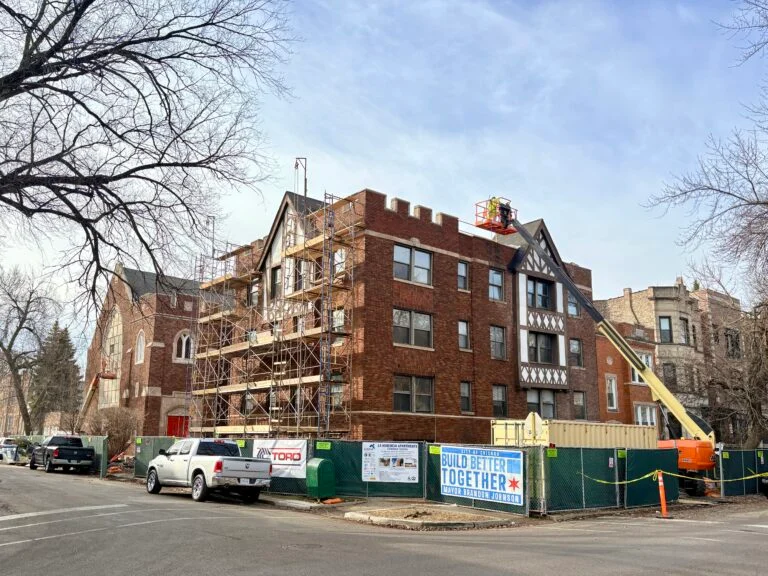
On the West and northwest sides of Chicago, where the corridors of real estate speculation and disinvestment careen perilously close to each other, architects are using legacy building stock to expand the footprint of non-profit organizations with burgeoning social missions. Future Firm’s Revolution Workshop building trades education hub, Lamar Johnson Collaborative’s casket-factory-turned-music-school, and the affordable housing slotted into a century-old church by Canopy all leverage tight budgets to capitalize on their existing architecture in a few subtle ways.
Finding Sanctuary: La Herencia
La Herencia expands affordable housing in the rapidly gentrifying Logan Square neighborhood by filling the sanctuary of the former Humboldt Park United Methodist Church with additional housing units; a process that required lining up 11 funding sources over many years. “A lot of Biblical expressions feel like they apply,” says Lincoln Stannard, co-executive director of LUCHA, the project’s affordable housing developer. “We’ve been wandering in the wilderness for 40 years.”
This time and travail was driven by two firsts. La Herencia will be the first church sanctuary in Chicago to be turned into housing units, and the first church in the city to be turned into 100 percent affordable housing. Selling the church to LUCHA was last best thing the congregation could do for the community they sought to protect fiercely. “We as a congregation have lost our Latinx families who have been displaced out of this neighborhood through the evils of gentrification,” Paula Cripps-Vallejo, Humboldt Park United Methodist Church’s reverend, said at a community meeting.
As such, Canopy’s design is bulwark of continuity. “We really wanted to maintain the flavor and feel of the original architecture,” says Jaime Torres, Canopy founder.
The sanctuary will host units on three levels. The upper story units reach high into the rafters and preserved wood trusses, 22 feet from floor to ceiling; enough room for a mezzanine space fit for an office or child’s playroom.
The church’s most prominent exterior feature is its triple-height arched Gothic window lined in wood tracery, and Canopy’s design will restore it and add operable sections. This window will span across multiple units, showcasing intimate scenes of family life where there was once only an empty clerestory void.
Canopy is also restoring and preserving the church’s Bavarian alpine wood-framed gables. It’s the slightest bit kitschy, but it’s a also reminder that importing design and building traditions into Chicago is a universal immigrant experience meant to make the city a bit of their own. “We chose to celebrate the ways this building has always been a part of the immigrant experience,” says Stannard.
“The most important thing,” says Torres, “is maintaining the legacy of this being a sanctuary for emigrating people to the city of Chicago.”
March 17, 2026